How to transfer files from Box to Dropbox — without downloading them first
Moving from Box to Dropbox? Copy your files across directly, server to server — no downloading, no re-uploading — and your Box originals are never touched. Includes what Box Notes do and what doesn't carry over.
Maybe your company is consolidating on Dropbox. Maybe a Box contract is ending and you need your files out before the account closes. Maybe you just prefer how Dropbox works. Whatever brought you here, you've hit the same wall everyone hits: there's no "send to Dropbox" button inside Box.
So most people do the only thing that looks possible — download everything out of Box, then upload it all into Dropbox. For a handful of documents that's fine. For a real account it's a slog: every file crosses your home connection twice, your laptop is tied up for hours, and if the connection drops halfway you're left guessing which folders actually made it.
There's a faster way, and it doesn't involve your computer at all.
Copy directly from Box to Dropbox — skip your laptop
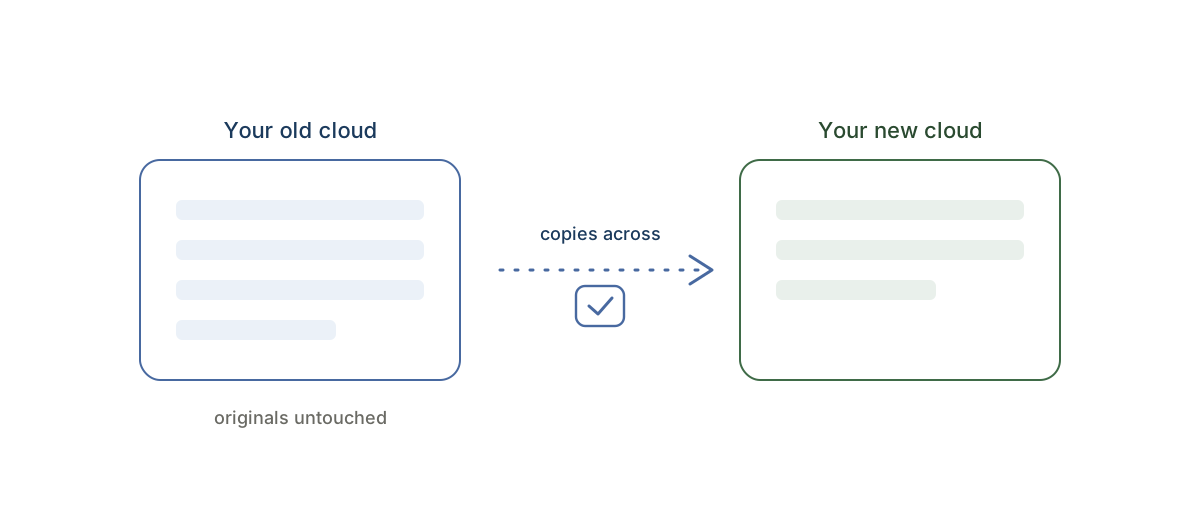
Your files don't need to travel through your machine. CloudRaft copies them straight from Box to Dropbox on its own servers. You pick the folders, confirm the plan, and close the tab — the copy runs in the background and you get an email when it's done. Your internet speed stops being the bottleneck, because your connection isn't in the path.
The whole job runs on the Box to Dropbox route page, and it's copy-only: CloudRaft reads Box and writes copies into Dropbox. It never deletes, moves, renames, or modifies anything in your Box account — that's enforced in code, not just promised in a policy.
Three things to check before you start
A migration you have to redo is the slowest migration of all. Before trusting any tool with a move like this, check:
1. It should be copy-only, so your originals can't be harmed. CloudRaft only ever reads from Box and writes copies to Dropbox. Because the Box side is read-only, your team can keep working in Box the entire time the copy runs. Worst case in any failure is that you run it again — your files exist in both places until you decide to clean up.
2. You should see the plan and price before anything starts. After you pick your folders, CloudRaft counts the files, totals the size, and shows the exact one-time price up front. Nothing copies until you confirm — a migration is a one-time event, so you pay for it once rather than subscribing.
3. You should be able to test it free first. Copy up to 10 GB free — no card, no expiry. Move one real Box folder, open it in Dropbox, confirm your Box files are untouched, and only then decide whether to move the rest.
How to do it
- Connect both clouds. Start free, connect Box as the source and Dropbox as the destination. Box sets permissions at the app level rather than per folder, so its consent screen covers your account; we only ever copy the folders you pick.
- Choose what to copy and review the plan. Select your Box folders. You'll see the file count, total size, and exact price before anything starts. Your folder structure is recreated in Dropbox as-is.
- Confirm and walk away. The copy runs on CloudRaft's servers — close the tab, shut your laptop. If it's interrupted it resumes where it stopped and never re-copies what's already done. You get an email when it's finished.
Where to look afterwards: your files land in a dated folder inside Dropbox's Apps folder — like Apps/CloudRaft — 2026-05-24 — not at the top level of your Dropbox. That's Dropbox's App folder permission doing its job: CloudRaft can only ever see and write to its own folder, never the rest of your Dropbox. Move the files wherever you like once the copy is done.
How long does it take?
It depends on total size and how fast Box and Dropbox allow data to be read and written — not on your laptop or your broadband. A few gigabytes usually finish in minutes; hundreds of gigabytes run in the background over hours. File count matters as much as size: ten thousand small files take longer than one large video of the same total. There's no cap on our side beyond what your Dropbox plan accepts.
For the full breakdown, see how long a cloud-to-cloud migration takes, or get a figure for your own move with the migration time & cost estimator.
What doesn't transfer (the honest part)
A few things can't be copied cleanly between Box and Dropbox, so it's worth knowing before you start rather than after:
- Box Notes. These are Box's own document format, not regular files. They copy across as
.boxnotefiles, which only open in Box. If you want them readable in Dropbox, export them to PDF or Word from Box before you migrate. - Sharing and collaboration permissions. CloudRaft copies your files, not Box's access settings. Shared links and invited collaborators don't carry over — you'll re-share from the Dropbox side.
- Version history. Each cloud keeps its own version history internally. The current version of every file copies across; older revisions stay behind in Box.
Everything that's an actual file — documents, spreadsheets, PDFs, photos, video — copies normally, with the folder structure intact.
A note on business accounts
You don't need admin rights, but you do need to be able to grant access to the folders you're copying. If your organization restricts third-party app access on either side, check with your admin before you start — that's the one thing that will stop a migration before it begins.
Where your data goes (and doesn't)
Files stream directly between Box and Dropbox through EU-hosted servers and are never stored along the way. CloudRaft holds your data in transit only — once the copy completes, nothing of yours remains on its systems. More on how we keep your data safe.
Try it with your own files, free
The easiest way to trust a migration tool is to watch it work on files you actually care about. Copy up to 10 GB free — no card, no expiry — or start from the Box to Dropbox page.